
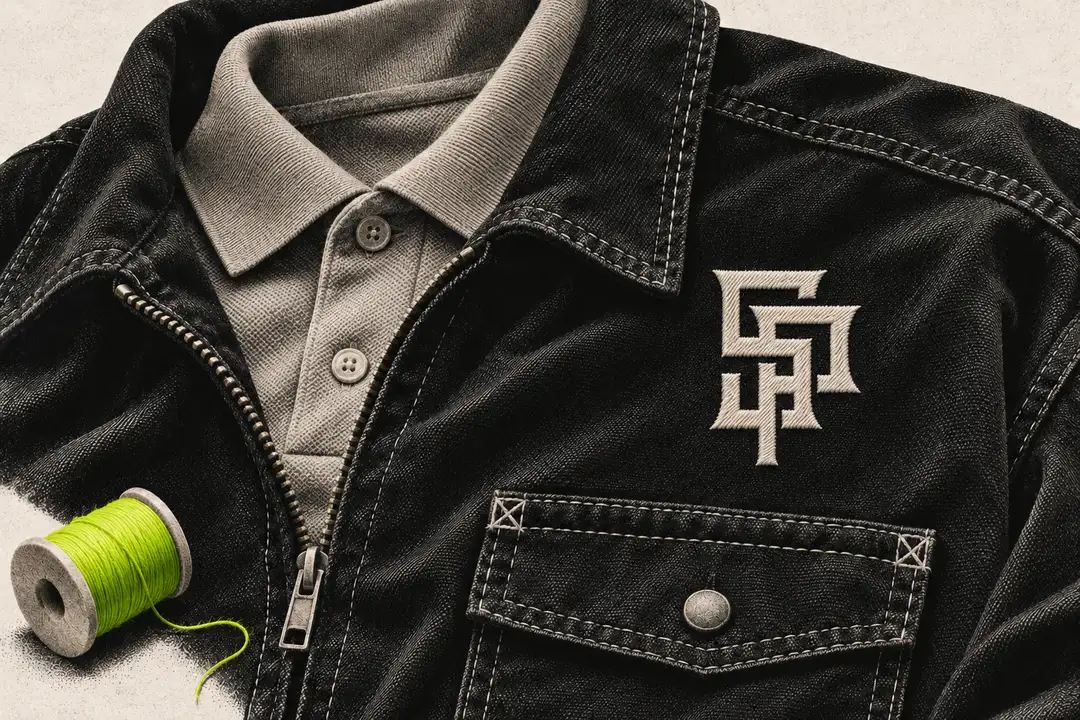
Start your embroidered workwear order with one everyday garment, a layer for the people who need it, and a logo you can read at the size it’ll actually be stitched. Collect sizes by exact garment style. Then save the approved styles, thread colors, logo placement, and size breakdown where the person who handles new hires can find them.
Here’s how to build the first order for a construction, landscaping, HVAC, plumbing, or service crew.
Start with what each person wears on the job
Walk through a normal day with the people who’ll wear the gear. A service technician might be in a customer’s kitchen at 8 a.m. and reaching under a sink an hour later. Their polo needs to look presentable, move with them, and feel comfortable after several hours on the job. A supervisor doing outdoor walkthroughs may wear a jacket over a hoodie and need enough room to reach and drive.
| Who wears it | Garment to consider | What to check on a sample |
|---|---|---|
| Service technicians and customer-facing crews | A short-sleeve or long-sleeve work polo | Reach overhead, bend, and check whether the shirt stays where you want it |
| Shop, yard, or installation crews | A work shirt or crew tee, with a sweatshirt if needed | Check sleeve and body length, ease of movement, and comfort at the decoration |
| Supervisors and estimators | A polo and a soft shell or midlayer | Try the outer layer over the clothes they wear most and confirm access to pockets |
| Office and dispatch staff | A matching polo or quarter-zip | Check fit options and whether the collar or zipper crowds the chest logo |
Use a shared color and a consistent logo where practical, such as a navy polo for service calls and navy outerwear for cold mornings. If your jobsite specifies protective clothing, have the person responsible for those requirements confirm the exact garment and whether it can be decorated. Track those items separately from the daily uniform.
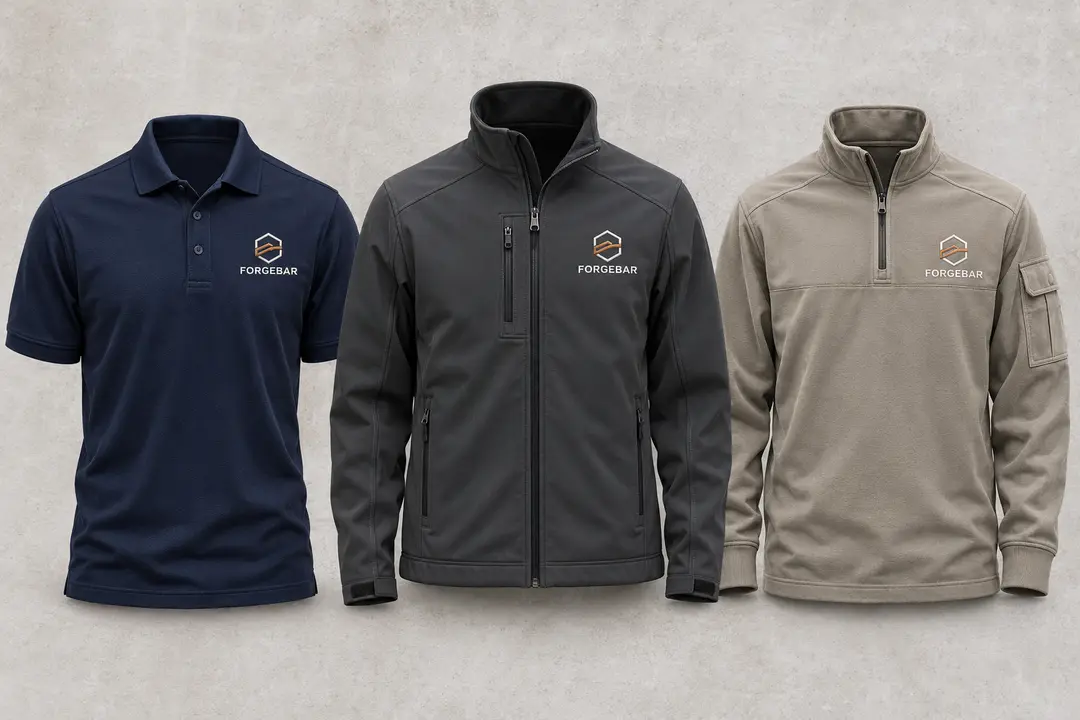
Choose work polos and jackets you can size and reorder
Compare the actual garment specifications before you pick from a catalog photo. On a polo, look at fabric weight, cut, body length, and care instructions. On a jacket, check the lining, closure, chest pockets, and room for base layers. Ask which colors and sizes are stocked in each cut. The same color name can look different across brands, so put samples side by side if the match matters.
Read both the body size chart and the finished garment measurements. For example, SanMar lists a 41–43 inch body chest for a large CornerStone CS450 polo and a 23½ inch chest measurement across the finished shirt laid flat. One number helps you match a person to a size. The other helps you compare the proposed polo with a shirt they already wear comfortably. Ask people to measure the comparison shirt in the same place as the spec sheet. SanMar’s CornerStone CS450 spec sheet
Hold a fit check before collecting the final roster if you can. Pass around a few sizes in the cuts you plan to order, including any fitted or tall options the crew asks for. For jackets, have people try them over the layers they’ll actually wear on the cold days. Record the exact style number with each size. A technician can comfortably wear a large in one polo, a medium in another, and an extra large jacket over a sweatshirt.
Also check how the crew will wash the garments. If you use a laundry service, share its process with the garment supplier and decorator. Include the manufacturer’s care instructions when you issue items.
Set the logo placement before you approve the order
A left-chest placement is a good starting point for a polo. Ask for the dimensions on the proof, and look at the artwork at roughly its intended size. A logo that reads clearly on a truck door can get crowded on a chest. Send your approved artwork and any alternate marks. If a small tagline or phone number crowds the design, try the approved wordmark or symbol by itself. Finer thread can help in some designs, so let the decorator evaluate what’s readable on the chosen fabric. Madeira’s guide to small embroidery lettering
Check placement on the actual jacket before you sign off. A chest pocket, zipper, or lining can change where the logo fits and how the decorator can get to that spot. Some jackets have a decoration access opening. The Port Authority J787, for example, lists both a zippered right chest pocket and an opening for decoration access. If two garments need different placements, have the proof show each one and make sure you’re happy with how the pair looks. SanMar’s Port Authority J787 spec sheet
Decide how you’ll handle names and role labels before you finalize quantities. If you want first names on polos, document the exact spelling, case, and placement for each employee. Keep spare stock with the company logo alone so it can go to anyone who needs that style and size. Before adding names to outerwear, work out how you’ll handle jacket exchanges and replacements.
Review the mockup and a stitched sample
A digital mockup shows which artwork goes on which item, in what color and where. Digitizing turns that artwork into stitch instructions. Those instructions account for how fabric reacts under the needle. Thread can pull the material inward as it stitches. Stitch spacing, underlay stitches below the visible design, and adjustments to the design’s edges help keep the surface smooth and adjoining shapes aligned. Wilcom’s guide to underlay and pull compensation
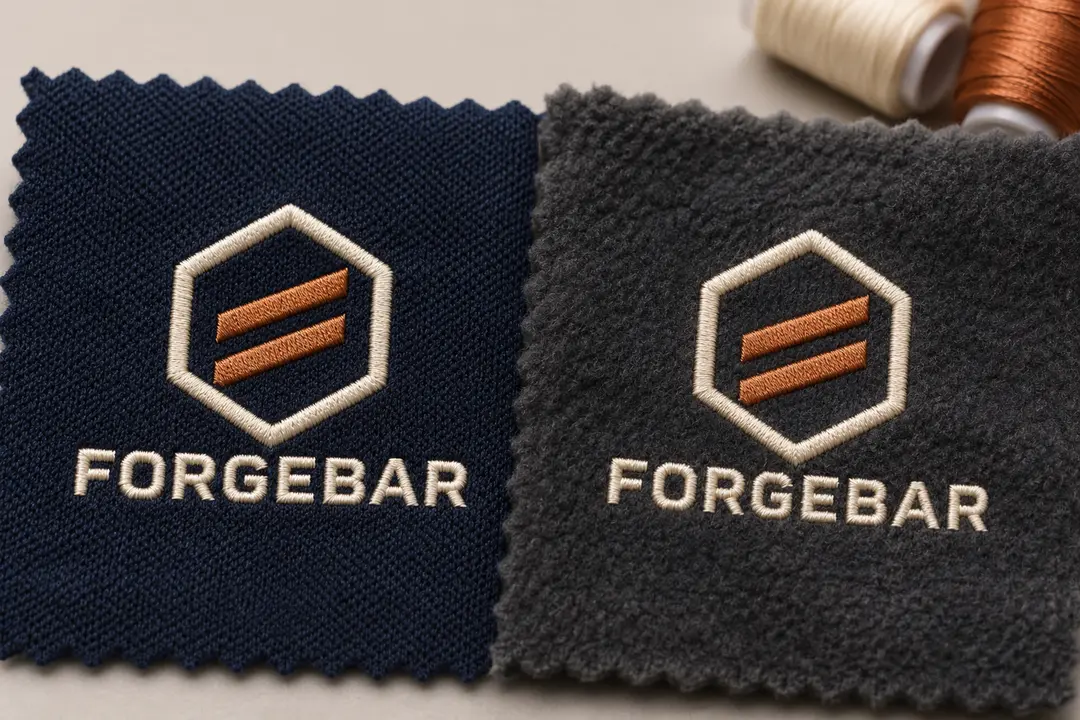
Ask whether you can review a sew-out, which is a stitched sample, and whether it uses the intended fabric. If the order includes a lightweight polo and a thick fleece, ask how the decorator will validate each. A stretchy knit may need stabilizer behind the fabric, and a high-pile fleece may benefit from a temporary film over the surface so the stitches sit above the fibers. Review any sample next to the garment color and under ordinary light. Madeira’s stabilizer guide · Madeira’s guide to topping for high-pile fabric
Use these questions when you review the proof or sample.
- Can you read the smallest lettering at the intended size?
- Do the thread colors stand out enough against the garment?
- Does the area around the logo lie flat?
- Does the placement clear pockets, seams, and zippers?
- How does the inside of the decoration feel where it touches skin?
- Do any changes to dimensions, garment style, or personalized text require a fresh approval?
Have one person record the final approval, with the garment code, logo dimensions, position, and color references. Save the proof and a photo of the approved sample with the order number. If you’re ordering in New England, see our options for custom embroidery for Greater Boston.
Build the initial order and keep the size counts separate
Start with a list of employees, their roles, and what each person gets. Then calculate totals for each combination of style, color, and size. A table with one row per person makes distribution easier. A second table with totals makes purchasing and reorders easier. Match those two views before submitting the quantities.
Here’s an example for a 24-person field service business. Every employee gets two polos. Twelve field leads and technicians who regularly work outside get a jacket. The team tries on the polo and jacket separately. Its results might look like this.
| Item | S | M | L | XL | 2XL | Total |
|---|---|---|---|---|---|---|
| Polos to issue | 2 | 10 | 16 | 14 | 6 | 48 |
| Extra polos for new hires or exchanges | 0 | 2 | 4 | 4 | 2 | 12 |
| Jackets to issue | 0 | 2 | 3 | 5 | 2 | 12 |
This team would request pricing on 60 polos and ask whether 12 jackets can be included, held for a later group order, or quoted separately. Its actual hires and exchanges should drive the spare sizes. If the company has a crew of six starting next month, it can collect those sizes while building the first order and quote them as confirmed pieces. Ask your decorator how minimums and setup apply across styles and across reorders before you count on combining the items.
Build the schedule backward from the day people need their gear in hand. Include time for a fit check, supplier stock confirmation, art review, any stitched sample, production, shipping, and internal distribution. Give your decorator the delivery ZIP code and the actual date the crew needs to wear the apparel.
Decide what happens when someone needs a replacement
Assign one person to handle the stock and keep one order record. Include the brand, exact style number and fit, color, size counts, previous order number, artwork version, thread references, finished logo dimensions, and position. Save any approved substitute alongside the primary style. If a garment is discontinued, try the substitute, confirm the fit and color, and review the decoration on the new fabric before approving it.
If you use a stock threshold, set it by size that people actually request. In the example above, suppose two new technicians each need two polos, and both wear large. That uses all four spare larges. If the company wants to cover the next hire, it could set a review point at two spare larges and check stock before the second technician is issued gear. The review is a cue to check upcoming hires, size demand, and reorder minimums together. The right restock quantity comes from who needs gear and when.
When placing a reorder, start with the prior order number and send the sizes and quantities that changed. Mention any differences in garment, color, artwork, or location. Confirm which of those changes need an updated proof. Keep the approved record close enough that a new person can pick up the job without having to reconstruct it from old emails.
Get a quote for your crew’s workwear
If you’re planning a first order, send us what the crew wears on the job, the pieces you’re considering, your rough counts, the company logo, and the date you need it. If you’re replacing existing uniforms, include a photo of the embroidery and the style number from the garment tag. At Strange Planet Printing, we’ll help you choose garments, work through placement, and see what you’re approving.